Wednesday, February 13, 2013

ICC President Song Addresses "Fight Against Impunity" at Columbia's World Leaders Forum

ICC President Judge Sang-Hyun Song speaking at the World Leaders Forum at Columbia University on February 12, 2013. Photo: Eileen Barroso / Columbia University
By Catherine Mullin

Judge Sang-Hyun Song, President of the International Criminal Court (ICC), spoke on The International Criminal Court and the Fight Against Impunity for Atrocity Crimes yesterday at Columbia University’s World Leaders Forum. Throughout his talk, in which he spoke from a personal perspective about his own experience in war and as a judge, Judge Song highlighted the importance of the ICC in the effort to end impunity. He declared the Court to be “at the forefront of the fight and a central element of the broad global system that brings together international organizations to address the worst international crimes.” Lee C. Bollinger, the President of Columbia University, introduced Judge Song. The event was co-sponsored by the Institute for the Study of Human Rights of which AMICC is a program.

Judge Song shared his first encounter with conflict, when he lived through the Korean War at the age of nine. The war is where he first saw the “immense suffering and destruction war creates.” Judge Song explained he chose to pursue a career in law, as he believes that law can prevent the worst violence. Though Judge Song survived the Korean War and went on to live in peaceful nations as he pursued his career, he pointed out that peace is seen as an “unattainable luxury” in many places in the world today. This reality reinforces the importance Judge Song sees to keep working towards the goal of eradicating mass violence. He urged that for those living in peace, “we must always ask ourselves what we can do with this gift.”

Judge Song reviewed the current situations and cases at the Court, and how each of these reflects that the Court is at the heart of the movement to end impunity. He emphasized that the ICC is not part of the UN, which is a common misconception, but instead is an independent body. However, he noted that peace and justice are interlinked. The relationship between the ICC and UN was established to be mutually reinforcing so both peace and justice could be achieved.

He addressed the challenges facing the Court, such as the failure to arrest and transfer individuals charged in the Darfur and Libya situations, and highlighted the importance of the cooperation of ICC States Parties. Judge Song emphasized that the support of States Parties and UN Security Council is imperative to the Court’s ability to function effectively. He believes states’ actions, or inactions, will determine the success of the Court. Judge Song also emphasized that ICC is a Court of last resort, and that states retain primary jurisdiction which is both a right and responsibility of each state.

Judge Song concluded with reflections on his own place in the ICC as a "world leader" of an international organization. He admitted, “to lead is to be alone in the eye of the storm. I carry the responsibility for the actions that I take.” He also stated that as president he is “first among equals” with his colleagues at the Court. The ICC is not a hierarchical institution, but made up of independent judges, Prosecutor and Registrar. This theme of the importance of independence ended his remarks: “The ICC cannot function unless it maintains its independence, and it must stand apart as a non-political judicial institution.”

In the questions and answers following his remarks, Judge Song spoke about his role promoting the universality of the ICC and the challenges faced in convincing large countries, such as Russia, China, India and the US, to join the Court. While acknowledging that domestic political realities may for now keep these countries outside of the ICC, such as the 67 votes requires in the Senate in order to permit US ratification, he expressed his appreciation for the Obama administration's support and cooperation, such as sharing intelligence and helping to support ICC arrests. President Song ended on a positive note. He declared that he was positive that one day the US will join "the ICC family" because the principles that the court defends are fully in line with American core values.

The webcast of the event will be archived on the World Leaders Forum website.

Friday, February 08, 2013

New AMICC Analysis of Acquittal and Release of Mathieu Ngudjolo Chui by the ICC

http://www2.icc-cpi.int/NR/rdonlyres/7935EF37-F06D-45DA-8BE5-3F9933F21BCB/277243/20080211IMG35.jpg
Mathieu Ngudjolo Chui during his initial appearance before the Court. Photo: ICC-CPI/Remco Okhuizen


On December 18, 2012 Mathieu Ngudjolo Chui was acquitted of all charges by the International Criminal Court. Trial Chamber II found there to be insufficient evidence in the case brought by the Office of the Prosecutor, and was unable to find Ngudjolo guilty beyond a reasonable doubt regarding the charges of war crimes and crimes against humanity. This is the second verdict delivered by the Court since its founding, and its first acquittal. The verdict was met with mixed reactions worldwide and has reenergized the examination of the ICC and its role in international justice.  

Read more in AMICC's new analysis of the Ngudjolo acquittal

Thursday, February 07, 2013

Trial Chamber Orders Immediate Surrender of Abdullah Al-Senussi to ICC by Libyan Authorities

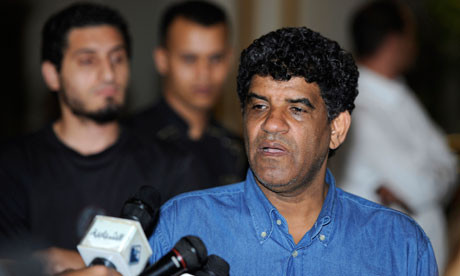
Abdullah al-Senussi, Libya's former director of military intelligence
Former head of Libyan Armed Forces and Military Intelligence Abdullah Al-Senussi. Photo: Paul Hackett /Reuters

By Catherine Mullin

The Judges of Trial Chamber I yesterday ordered Libyan authorities to immediately transfer Abdullah Al-Senussi to the ICC. Al-Senussi, the former head of the Libyan Armed Forces and Military Intelligence, is wanted by the Court on charges of crimes against humanity. An arrest warrant for Al-Senussi was issued by the Court in June 2011. The UN Security Council referred the situation in Libya to the ICC in February 2011, the first unanimous referral to the Court by the Security Council. The referral gave the Court jurisdiction over Libya, though it is not a State Party.

The Libyan government contested the admissibility of the case against Saif Al-Islam Gaddafi, his co-defendant, after the arrest warrant for them were issued, but the challenge did not include the case against Al-Senussi. This appears to have been decisive; according to the judges, "the postponement of a surrender request pursuant to [Article 95 of the Rome Statute] can only be made '[w]here there is an admissibility challenge under consideration'." No such admissibility challenge is underway and thus Libya may not "postpone the execution of a request under this Part pending a determination by the Court," as provided for in that article.

In January 2013, the Libyan authorities claimed to be nearing the beginning of pre-trial proceedings for Al-Senussi in their own Chamber of Accusation. However, there has been no evidence of any such action by the Libyan government. Al-Sensussi’s defense team has repeatedly requested his immediate transfer to the ICC, but to date Al-Senussi remains in Libyan custody. Today's decision also sets in motion a possible visit by Al-Senussi's ICC-appointed lawyer to his client in Libya.

Wednesday, January 23, 2013

IWPR Reports on Washington's Growing Ties with ICC, Quotes AMICC Convener John Washburn

The Institute for War & Peace Reporting (IWPR) today released a special report on Washington's growing ties with the International Criminal Court, with extensive quotes from ICC and US officials as well as AMICC's Convener:
John Washburn, convener of AMICC, a coalition of NGOs advocating for the US to join the international court, says that such open hostility to the ICC is now a thing of the past. Recognising that the ICC is here to stay, Washington wants at the very least to engage with it. Meanwhile, a September 2012 poll by the Chicago Council on Global Affairs found that as many as 70 per cent of American respondents thought the US should join the court.

So is the US likely to become a fully signed-up member of the ICC any time soon? Although AMICC has been calling for this for years, Washburn retains a sense of pragmatism.

“In all likelihood, any realistic chance of ratification is several years away at best,” he said. “Nonetheless, preparing in advance for that chance will also require a year or more, since the legal, constitutional, political and bureaucratic obstacles are so severe and complicated.”
Read more

Wednesday, January 16, 2013

ICC Prosecutor Opens Investigation into Alleged War Crimes in Northern Mali


By Catherine Mullin

ICC Prosecutor Fatou Bensouda announced today that she has formally opened an investigation into the Situation in Mali since January of 2012. Mali had previously been under preliminary examination by the Court after the case was referred to the ICC by the Malian government on July 18, 2012. After thorough analysis the Prosecutor has found that evidence, admissibility, gravity of potential cases, and interest of justice all support the requirements to open a formal investigation into war crimes allegedly committed in Mali.

“Since the beginning of the armed conflict in January 2012, the people of Northern Mali have been living in profound turmoil,” said Prosecutor Bensouda. “At each stage during the conflict, different armed groups have caused havoc and human suffering through a range of alleged acts of extreme violence. I have determined that some of these deeds of brutality and destruction may constitute war crimes as defined by the Rome Statute.”

As a result of the preliminary examination Prosecutor Bensouda has found there to be reasonable evidence that war crimes have been committed in Northern Mali. Crimes alleged to have happened include murder; mutilation, cruel treatment and torture; intentionally directing attacks against protected objects; the passing of sentences and the carrying out of executions without previous judgement pronounced by a regularly constituted court; pillaging; and rape. The ICC will move to investigate these alleged crimes and bring charges against individuals “who bear the greatest criminal responsibility for the most serious crimes committed.”

Monday, January 07, 2013

New US Law to Permit Rewards for Persons Wanted by ICC, Including Joseph Kony

On January 3, the House passed and sent to the President S.2318, The Department of State Rewards Program Update and Technical Corrections Act of 2012. President Obama signed it on January 15, thus bringing it into law, thereby expanding Rewards for Justice. Behind its dry and technical-sounding title lie provisions which move Congress and the Administration perceptibly further toward a closer general relationship with the International Criminal Court.

The original law began in 1984 and was then directed at promoting arrests in conventional international organized crime such as drug trafficking, and of terrorists. However, in the last two years, Ambassador-at-Large for Global Criminal Justice Stephen Rapp has led a State Department effort to expand the law to include the atrocity criminals whom the ICC tries. The bill which became S.2318 was introduced in the House by Congressman Ed Royce (R-CA), who is chairman of the House Committee on Foreign Affairs in the new Congress. It had 57 bipartisan sponsors and passed the House in July. Senator Kerry, chairman of the Senate Foreign Relations Committee, introduced S.2138 itself in the Senate which passed it on December 20.

The new law declares "the sense of Congress that the rewards program of the Department of State should be expanded in order to ... target other individuals indicted by international, hybrid or mixed tribunals for genocide, war crimes, or crimes against humanity." It then goes on to authorize the State Department to pay rewards for "the transfer to or conviction by an international criminal tribunal ... of any foreign national accused of war crimes, crimes against humanity, or genocide, as defined under the statute of such tribunal."

Two provisions of the law show a continuing wariness about the ICC. One requires that 15 days before announcing a reward for the arrest of a particular foreign national accused of those crimes, the State Department must submit a report to Congress explaining why the arrest would be in the national security interest of the United States. The other declares that the law does not authorized activities precluded under the American Servicemembers' Protection Act.

The worldwide attention to the crimes of Joseph Kony, leader of the Lord's Resistance Army, and the previous individual laws referring to the ICC's work on specific cases were among the elements of the impetus for this new law. A future post will analyze the trends behind its passage, and its importance for our current advocacy and our strategy for the future.

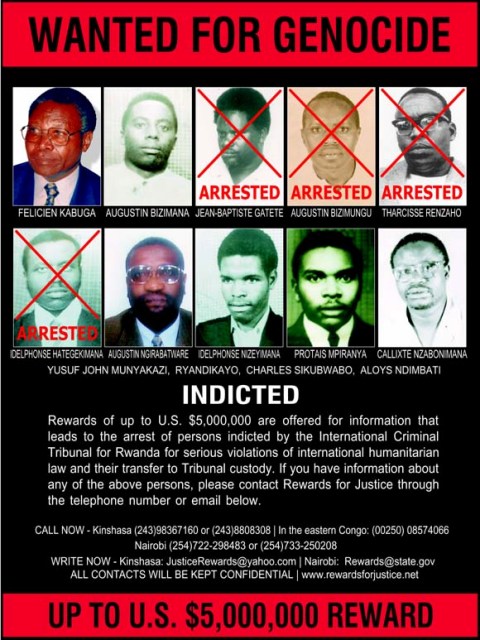
Wanted poster, published by the Rewards for Justice program, seeking key perpetrators who have been indicted by the International Criminal Tribunal for Rwanda (ICTR).
A US State Department poster announcing rewards for individuals wanted by the UN International Criminal Tribunal for Rwanda.

Tuesday, December 18, 2012

AMICC Welcomes the International Justice Project as its Newest Member Organization

Wanda M. Akin (IJP Co-Founder), Carine Bonduelle (IJP Program Officer), Luc Walleyn (Legal Representative for Victims in Lubanga), Afi Patterson, Esq. (IJP Volunteer), and Raymond M. Brown (IJP Co-Founder) at the 2012 List of Counsel Meeting in The Hague.
AMICC is pleased to welcome its newest member organization, the International Justice Project. The IJP joined AMICC on December 12 and is its 39th institutional member. AMICC is a coalition of NGOs committed to achieving through education, information, promotion and an aroused public opinion full United States support for the International Criminal Court and the earliest possible US ratification of the Court's Rome Statute.

The IJP, a 501(c)(3) nonprofit organization based in Newark, NJ, promotes and advances human rights through the rule of law. Through transitional justice mechanisms, it also provides holistic support to victims of the world’s most heinous crimes—genocide, crimes against humanity and war crimes. The IJP works across sectors and disciplines and at the local and policy levels to help victims heal and rebuild their lives. This unique and holistic approach incorporates individual criminal justice and accountability, advocacy, human rights, education, and health, and it allows the IJP to have long-lasting, sustainable effects.

The co-founders of the IJP, Wanda M. Akin, Esq. and Raymond M. Brown, Esq. are two of only 50 American lawyers who are List of Counsel at the International Criminal Court. Presently, they represent 11 victims in the Darfur situation and four victims in The Prosecutor v. Omar Hassan Ahmad Al Bashir, the case against the President of Sudan. The IJP supports the victims in this process, reaching out to those interested in participating in the proceedings and also to those who may not qualify for participation. To date, the IJP has identified and compiled data from hundreds of potential victims in the Darfurian Diaspora in Sudan, Chad, Netherlands, and the United States, including Arizona, Indiana, Maine, New Hampshire, New Jersey, New York, and Pennsylvania.

Learn more about institutional membership in AMICC.

ICC Acquits Mathieu Ngudjolo Chui of the DRC, Defendant in ICC's Second Trial, Due to Evidence


On December 18, 2012 Trial Chamber II of the ICC acquitted Mathieu Ngudjolo Chui, a defendant in the Court's second case, because it found that the Office of the Prosecutor had not proved his guilt beyond a reasonable doubt. Accordingly, the Trial Chamber has ordered the release of Ngudjolo Chui but he will continue to be held pending a decision on the request of the Prosecutor for an appeal. This verdict affirms the careful deliberations and consideration of the Court's judges for the evidence as well as their commitment to ensuring due process for defendants. The acquittal reminds us that the judges are an effective check on the Prosecutor and will not convict all defendants who are charged by the Court.

Ngudjolo Chui was charged with nine counts of war crimes and crimes against humanity, including murder, sexual slavery, inhuman treatment, the use child soldiers in hostilities, and unlawful attacks against civilians. He and Germain Katanga were joined in a single case for trial which began on November 24, 2009. The Trial Chamber recently severed the cases. The judges have yet to decide on the guilt or innocence of Katanga.

The verdict is currently available in French. Once an English version is available, we will post it to our website.