Thursday, September 06, 2012

Preview of Upcoming International Criminal Court Cases, Activities and US Events

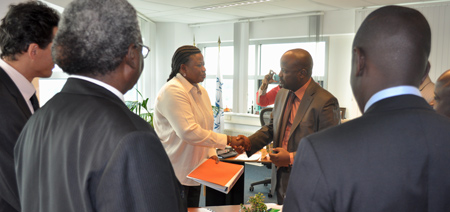
Then-ICC Deputy Prosecutor Fatou Bensouda at a news conference in Guinea in 2010. Photo by Joe Penney.

By Audrey Kim

This summer was full of milestones for the ICC: Prosecutor Fatou Bensouda was sworn in as the ICC’s new prosecutor, the ICC handed down its first sentence and decision on reparations in its case against Thomas Lubanga Dyilo of the DRC, and Mali referred the situation in its territory to the OTP for a potential investigation. This fall, the ICC will continue to make progress in its cases and in its role in the enforcement of global justice and the deterrence of atrocities.

Progress in Cases before the ICC

Since the entry into force of the Rome Statute on July 1, 2002, 16 cases in seven situations have been brought before the ICC. Earlier this year, the Court handed down its first verdict, sentencing order and decision in the case against Thomas Lubanga of the DRC. Other cases before the Court continue to progress at the ICC.

In the case against Lubanga, the Court will implement and enforce the reparations for victims. As this is the first time the ICC has issued a reparations decision, its execution will have significant implications for its relationship with victims and future reparations. The prosecution and defense will also have the opportunity to appeal the verdict against Lubanga as well as the 14-year sentence. The deadline for appealing the verdict is 30 days from August 31, the date that the official French transition was made available to the parties.

Also part of the situation in the DRC, the trial of Germain Katanga and Mathieu Ngudjolo Chui was concluded on May 23, 2012 when the defense concluded the presentation of its case. The judges have begun deliberations after 240 hearings and will issue a verdict in the near future.

On September 3, 2012 the trial of Jean-Pierre Bemba Gombo of the Central Republic of Africa resumed in Trial Chamber III. This is the ICC’s third trial, and it started in November 2010. The defense case started in August of this year. As the alleged President and Commander-in-Chief of the Mouvement de Libération du Congo, Bemba is allegedly criminally responsible for two counts of crimes against humanity of murder and three counts of war crimes of murder, rape and pillaging.

Although unconfirmed, this fall the ICC will also likely hold the confirmation of charges hearing in the case of Laurent Gbagbo, the former President of Côte d'Ivoire. He is charged with alleged co-perpetration of crimes against humanity of murder, rape and other sexual violence, prosecution, and other inhuman acts. The date of his confirmation of charges hearing was postponed from August 13, 2012 to an undetermined date to allow the state of his health to be assessed.

The situation in Kenya, which consists of two cases, has been the subject of much international attention. Opening of trials for the case of William Samoei Ruto and Joshua Arap Sang is scheduled for April 10, 2013 and on April 11, 2013 for the case of Francis Kirimi Muthaura and Uhuru Muigai Kenyatta.

In the case against Banda and Jerbo in the Darfur situation, Pre-Trial Chamber I confirmed the charges of war crimes and assigned the case to Trial Chamber IV. The date of the trial remains unconfirmed.

In the Libya situation, Libyan prosecutors have claimed that they will try Saif Al-Islam Gaddafi in national courts in the town of Zintan. Recent report indicate that Abdullah Al-Senussi, the former Libyan military intelligence chief, has been transferred from Mauritania to Libya. Both are wanted by the ICC for crimes against humanity of murder and persecution. There is concern over whether Libyan courts will conduct a fair trial. As this situation has been referred to the ICC by the UN Security Council, the UN will be closely following the situation and hopefully will ensure that the suspects are brought before the ICC. Yesterday, the US encouraged "the Government of Libya to maintain its cooperation with the International Criminal Court in accordance with Security Council Resolution 1970" and called on Libya, if it decides to conduct domestic trials, to "try [ICC suspect Abdullah Al-Senussi] fairly in full compliance with their international obligations."

The OTP will also make progress in its preliminary investigations and other potential cases that have been brought to its attention. Particularly regarding alleged crimes in Mali that were referred to the ICC on July 18, the OTP will likely announce whether it will open a formal investigation. A referral does not require the OTP to take the case, and the OTP will soon determine whether the situation is under the ICC’s jurisdiction and if it will act.

The ICC in International Politics

The ICC continues to establish itself as an international organization and to build political support for cooperation and arrests. The Court also enjoys a close relationship with the United Nations. Recently, however, the Court has been facing serious budget constraints imposed by its members. This situation is very grave because it reduces the Court’s resources just as its natural growth is speeding up. This will limit the functionality and effectiveness of trials, proceedings, and investigations at the ICC.

ICC President Song will report to the UN General Assembly at the UN Headquarters in New York in late October. Since 2005, the President of the Court has reported annually to the UN on ICC’s activities and progress in its cases, pursuant to the Negotiated Relationship Agreement between the ICC and the UN concluded on October 4, 2004. This is the formal basis of the mutual beneficial cooperation between the ICC and the UN. The President will likely address the progress of judicial proceedings and investigations and discuss further international cooperation with the UN and ICC States Parties.

In November and December, Prosecutor Bensouda will present biannual reports on the situations in Darfur and Libya to the UN Security Council at the UN Headquarters, New York. The situations in Darfur and Libya were referred to the ICC by the UN Security Council on March 31, 2005 and February 26, 2011, respectively. This is the first time that Mrs. Bensouda will address the UN Security Council as the new prosecutor. She will likely focus on the enforcement of ICC warrants and potential actions the UN Security Council could take to support the Court.

From November 14-22, the Assembly of States Parties (ASP) will hold its eleventh session in The Hague. This follows the 19th Session of the Committee on Budget and Finance on September-October 2012, which will address budget reductions. At the 10th ASP session last year, State Parties were primarily focused on budget issues and could not address other matters fully. Thus, much of the budget discussions will likely take place in the Committee on Budget and Finance and the subsequent Hague Working Group this year so the ASP will have more time and flexibility to discuss other issues important to the Court. AMICC is closely following the budget constraints at the ICC because this affects the ICC’s ability to be an effective, fully functioning court and this provides material for ICC critics in the US.

Also, it is expected that a Deputy Prosecutor for the ICC will be elected in November. The Prosecutor nominates three candidates for the position, and the Deputy Prosecutor is elected by a secret ballot by members of the ASP.

The ICC in the US

The ICC continues to be in focus in the US, particularly through the activities of civil society. Upcoming events demonstrate support for the ICC and commemorate its 10th anniversary:

On September 10, the Philadelphia Global Initiative will hold a conference on The Rule of Law: Celebrate-Reflect-Promote in Philadelphia. This conference is a response to the ABA’s call for education about the ICC. This conference will celebrate the 10th anniversary of the ICC in conjunction with the 225th anniversary of the signing of the US Constitution in Philadelphia. Speakers include US Ambassador for Global Criminal Justice Stephen J. Rapp and AMICC Convener John Washburn.

AMICC Convener John Washburn will speak at Through the lens of Nuremburg: The International Criminal Court at its tenth anniversary on October 4-5 in Nuremburg, Germany. This conference will mark the 10th anniversary of the entry into force of the Rome Statute and focus on the role of Nuremburg principles in the development of international criminal law and the ICC.

The Whitney R. Harris World Law Institute will host an international conference in St. Louis, Missouri on November 11-12, the International Criminal Court at 10. This conference will commemorate the ICC’s tenth anniversary and will focus on the Court’s progress, future, and US relationship with the Court. This event will take place right after the elections, which AMICC is closely following because of its implications on future US-ICC relations. Speakers will include ICC Judge Hans-Peter Kaul, ICC Judge Joyce Aluoch, US Ambassador for Global Criminal Justice Stephen J. Rapp, and AMICC Convener John Washburn.

On December 7, the Program on Human Rights’ Sanela Diana Jenkins International Human Rights Series will present One Decade of the International Criminal Court: Challenges and Possibilities in Stanford, California. This event will address current challenges and possibilities for the ICC, such as reparation, US-ICC Relations, and the crime of aggression.

Find more information on AMICC's Event Calendar.

Our thanks to Audrey Kim for researching and drafting this message.

Wednesday, September 05, 2012

Major Party Political Platforms and the ICC

The two major US political parties have recently completed their national party platforms which either mention the ICC or its cases. Both of the platform documents, adopted by the national conventions in Tampa and Charlotte, reflect the official positions of the national political committees on major issues. They will not necessarily dictate the positions of the respective candidates. AMICC has analyzed and compared the Democratic and Republican platforms from 2008 and 2012 on the issues of the ICC and international justice.

As in the 2008 platform, the Democratic platform does not explicitly mention the ICC. It does, however, repeat the commitment expressed in 2008 about bringing to justice those who commit genocide and war crimes. In a subsection on Africa, in the section titled "Strengthening Alliances, Expanding Partnerships, and Reinvigorating International Institutions," the platform even mentions an ICC case by referring to bringing "to justice those who commit mass atrocities, like Joseph Kony." The decision to refer to the Kony case in particular, which both the administration and members of Congress believe should be tried before the ICC, is likely a result of the public outcry over his alleged crimes. The decision not to include the ICC by name reflects the cautious, case-by-case approach of the Obama administration which would likely prefer not to debate the issue of the ICC with the most vocal elements of the Republican party which negotiated the Republican platform and remain hostile to the Court.

The Republican platform repeats the party's hostility to the ICC by rejecting its jurisdiction. However, there are some noticeable differences. First, in the section on "Sovereign American Leadership in International Organizations," there is no longer a specific reference to the American Servicemembers' Protection Act (ASPA); it has been replaced with the phrase "statutory protection for U.S. personnel and officials." This may signal a willingness to make changes to anti-ICC legislation, as argued by former Bush official and current Romney adviser John B. Bellinger III, in ways that better promote US national security interests. The second major difference is that the platform refers to the party's opposition to the Court in another section, on "American Sovereignty in U.S. Courts." The text of this section seems to conflate US participation in the ICC with the use of the law of other nations, or perhaps international law, in domestic proceedings. It appears to overlook several relevant circumstances. After all, the ICC is intended to encourage the investigation and trial of individuals in domestic court systems using national laws. In fact, Congress has passed bipartisan legislation to ensure that serious atrocity crimes do not go unpunished. In addition, the platform seems to be at odds with the views of Republican members of Congress, several of whom have recently introduced or co-sponsored resolutions or bills recognizing the jurisdiction of the ICC and urging that specific persons suspected of atrocity crimes be tried by it.

The two party platforms do not necessarily reflect the views of the presidential candidates or predict how they will act if elected. President Obama, if reelected, would likely continue his administration's cautious but open and thoughtful approach of "principled engagement" with the Court. This involves case-by-case interaction with and support to the the ICC and vigorous participation as an observer in the Court's Assembly of States Parties. President Romney would likely recognize the value of the ICC, its permanence and its potential for bringing to justice those who commit atrocity crimes, while also acknowledging the concerns raised by his party's platform. A Romney administration would have a lower-profile relationship with the Court, but would not regress to hostility. It would more quietly work with the Court on issues it considered in the US national interest and/or had been identified by Congress or public opinion. The ICC as such is unlikely to be a campaign issue, but specific country situations involving the Court may be.

Wednesday, August 08, 2012

Trust Fund for Victims, After Lubanga Conviction, To Implement ICC's First-Ever Reparations

By Stephanie Kammer


Yesterday the ICC issued, in the case of Thomas Lubanga Dyilo, its first-ever decision on reparations to victims under Article 75 of the Rome Statute. The Chamber's Decision establishing the principles and procedures to be applied to reparations is "deliberately comprehensive," a style which has become a kind of signature for many of the Lubanga Trial Chamber's decisions, including the verdict in the case.

The Trial Chamber emphasized the importance and uniqueness of reparations as a feature of the ICC. The reparations process focuses on considerations beyond the punishment of a crimes, such as rehabilitation and redress for victims. The Chamber explained that "the Court is mainly concerned at this juncture with the victims, even though the prosecution and the defence are also parties to the reparations proceedings."

Victims advocates wanted crimes of sexual violence considered during the reparations portion of the trial, even though crimes of sexual violence were not included in the charges brought against Lubanga. The Trial Chamber addressed this concern by treating reparations "in a broad and flexible manner, allowing ... the widest possible remedies for the violations of rights of the victims and the means of the implementation."

Among the Principles set out by the Chamber to guide the reparations process were:

- That reparations should be non-discriminatory and gender-inclusive.
- That reparations take into account the needs of all the victims, particularly children and victims of sexual or gender crimes.
- That reparations be sensitive to cultural variations and contexts.
- That priority be given to especially vulnerable victims.

The Chamber delegated most of the implementation of reparations to the Trust Fund for Victims (TFV). It determined that a new Trial Chamber should be constituted to monitor and oversee the work of the TFV. The Chamber endorsed a five-step plan put forth by the Trust Fund for implementation, which focused on outreach and involving victims at the local level:

(1) The TFV, the Registry, the OPCV, and the experts, should establish which localities ought to be involved in the reparations process.
(2) There should be a process of consultation in the localities that are identified.
(3) An assessment of harm should be carried out during this consultation phase by the team of experts.
(4) Public debates should be held in each locality in order to explain the reparations principles and procedures, and to address the victims' expectations.
(5) The collection of proposals for collective reparations that are to be developed in each locality, which are then to be presented to the Chamber for its approval.

One of the main practical questions facing the Trial Chamber was whether reparations should be collective or individual or some combination thereof. The decision opened with a discussion of the concerns expressed by non-governmental organizations, the legal representatives of the victims, the Registry, and the parties about the pros and cons of collective versus individual reparations.

The legal representatives for a group of victims submitted that the victims they represented did not have homogenous views on what constituted appropriate reparations and that "they should not be treated as a single group and instead they should be treated as individuals." The Chamber noted that this group was composed mostly of males. The NGO Women's Initiatives for Gender Justice, argued that individual reparations favored victims participating in the reparations process (the Chamber received eighty-five applications for reparations) over the large number of victims who did not participate in the proceedings. Women's Initiatives argued that reparations should reach unidentified victims, particularly women and girls. It could be gleaned from the decision that generally, collective reparations were favored by groups representing female victims but in certain cases female victims could also benefit from individual reparations, such as treatment for sexually transmitted disease. The Chamber noted that since Thomas Lubanga was found to be indigent, reparations will be financed by the Trust Fund for Victims, which tends towards collective reparations.

Suggestions by victims and victims groups about the form reparations should take seemed to fall into three categories: reparations to empower victims economically and to stimulate local economic development, reparations to help heal the physical and mental health of victims, and symbolically reparations like a memorial.

The Trust Fund for Victims welcomed its substantial role in the reparations process and hailed the decision as "a historic milestone for victims of international crimes." The Fund was set up by the ICC’s governing body, the Assembly of State’s Parties (ASP) in 2002 and currently has a total income of $5.5 million. $2.7 million has been set aside for grants in the DRC and Uganda.

Although the Chamber's decision is not binding on future cases, the principles and procedures set out may be used by future Trial Chambers where they are practicable. It is possible that in a future case, where a defendant has means, a Trial Chamber may order individual reparations, or a combination of individual and collective reparations.

Monday, August 06, 2012

AMICC Relaunches its Website, www.amicc.org

We are pleased to announce the launch of AMICC's new website, the latest improvement of many to our work since becoming a program of the Columbia University Institute for the Study of Human Rights (ISHR) late last year. The new site, still at www.amicc.org, is designed to better serve AMICC's constituents, as well as practitioners, academics and the general public, by providing more current information on the work of the ICC and through better organization. It remains a repository of information on the US relationship with the ICC and we hope it will continue to be a leading resource on this topic. It is the only site we know of dedicated solely to that relationship.

The new website would not have been possible without the valuable time and technical assistance of ISHR staff member Joe Kirchhof who completely designed and coded it from scratch. It is in HTML5, the latest version of this programming language, and based on a lightweight, custom PHP framework. Unlike the previous AMICC website, which was launched in 2002, the new one is better equipped to incorporate multimedia and social media. The design remains simple, and we have been sure to include all of the information that was on the old site. Some of it has been condensed.

An early sketch of the new website.


We have also taken the time to ensure that none of the old links have been "broken." For example, if you go to a bookmark of one of the old pages, it will take you to the corresponding new page; thus if you go to http://www.amicc.org/calendar (from the old site), that will automatically lead to http://www.amicc.org/about/calendar. If you have trouble finding what you are looking for, we hope that the enhanced top and side menus and search box will be of help.

The new site is also much easier for us to update and change in response to new developments. We consider it to be an ongoing work in progress that will benefit from the input of our partners. We encourage you to take a look at the new site and let us know what you think.

Wednesday, July 25, 2012

US Secretary of State Hillary Clinton Addresses Prevention of Genocide and Atrocities at US Holocaust Memorial Museum

By Audrey Kim 
On July 24, 2012 Secretary of State Hillary Clinton delivered the keynote address at “Imagine the Unimaginable: Ending Genocide in the 21st Century”  a symposium hosted by the United States Holocaust Memorial Museum in cooperation with the Council on Foreign Relations and CNN. The symposium focused on practical steps and challenges of preventing genocide.

When the Secretary of State outlined the US’s actions and steps to prevent atrocities, she mentioned several situations that are under ICC jurisdiction, such as Libya, Laurent Gbagbo of Cote d’Ivoire, and Joseph Kony of the Lord’s Resistance Army. Notably, she mentioned the International Criminal Court when she described how the Administration was acting on its commitment to the prevention of genocide and atrocities. 

"So if a government cannot or will not protect its own citizens, then the United States and like minded partners must act. But let me hasten to say this is not code for military action. Force must remain a last resort, and in most cases, other tools will be more appropriate through diplomacy, financial sanctions, humanitarian assistance, law enforcement measures.

The Administration has acted on this commitment. When the Qadhafi regime threatened a massacre in the city of Benghazi, we forged an international coalition to stop the assault. When Laurent Gbagbo violently clung to power in Cote d’Ivoire, we worked with UN partners to prevent the killing of innocents and to pressure him to relent. Now, he is standing before the International Criminal Court. When the Lord’s Resistance Army escalated its attacks against civilians and its brutal work of turning children into soldiers, we helped governments throughout Central Africa increase their efforts to go after the leaders, including Joseph Kony."

Secretary Clinton also focused on the role of the recently established Atrocities Prevention Board.

"We’re putting our elements of this strategy – prevention and partnership – into action through the Atrocities Prevention Board that President Obama announced here. Now, it might not be obvious that creating yet another government board will address a problem as entrenched as this. But the fact is a body such as this can drive the kinds of institutional changes that we envision. It can help galvanize efforts across our government to focus on prevention, to ensure that all our tools and resources are being put to good use."

In her speech, Mrs. Clinton emphasized the necessity of prevention of future genocides. “The United States and our partners must act before the wood is stacked or the match is struck, because when the fire is at full blaze, our options for responding are considerably costlier and more difficult,” she said. 

Wednesday, July 18, 2012

New State Party Referral to the ICC: Government of Mali Requests OTP Investigation

 Malian Minister of Justice, H.E. Malick Coulibaly and ICC prosecutor Fatou Bensouda  
By Audrey Kim 
On July 18, 2012, the Government of Mali referred “the situation in Mali since January 2012”   to the Office of the Prosecutor (OTP). Mali is a state party to the ICC, as it ratified the Rome Statute on August 16, 2000. A delegation from Mali led by Minister of Justice H.E. Malick Coulibaly transmitted a letter and supporting documentations to Prosecutor Fatou Bensouda, and the Government of Mali claimed that Malian courts are unable to prosecute or try the perpetrators. 

The referral by the Government of Mali is the fourth referral by an African State Party to the ICC. The Malian Cabinet decided on May 30, 2012 to refer the situation to the ICC, and the ECOWAS Contact Group of Mali requested the ICC to investigate the situation on July 7, 2012. 

Violence erupted in Mali on January 17, 2012, and the Prosecutor has been closely monitoring the situation in Mali. There are reported instances of killings, abductions, rapes, conscription of children, and the deliberate destruction of the shrines of Muslim saints in the city of Timbuktu. The OTP is immediately launching a preliminary examination of the situation in order to assess whether the Rome Statute criteria for opening an investigation are fulfilled. 

A Look into the Situation in Mali
Mali, a former French colony, was once considered one of the most stable countries and as a democratic model in West Africa. Mali has a long history of Tuareg secessionist rebellions and Islamist separatist groups.  

On January 17, 2012 the National Movement for the Liberation of Azawad (MNLA), which is predominantly Tuareg, launched rebellion attacks on Ménaka in North Mali, resulting in mass violence and many civilian deaths. The situation in Mali is linked to the downfall of Muammar el-Quadaffi, in Libya. The Tuaregs fought for Colonel Qadaffi when he struggled to stay in power, and after his death a flood of weapons bolstered the Tuareg rebels in Mali. 

On March 22, 2012 the Army overthrew the elected government of President Amadou Toumani Touré and Dioncounda Traoré was sworn in as interim president. The Army accused the elected government of not doing enough against the MNLA and the Islamist groups

Meanwhile, Tuareg rebels and Islamist groups seized much of northern Mali, including the historic city of Timbuktu.  On April 6, 2012, the MNLA proclaimed the independent state of Azaward in Northern Mali. 

In June and July, the Islamist group Ansar Dine destroyed religious shrines in Timbuktu, provoking international outrage. On July 1, 2012  Prosecutor Bensouda condemned the campaign to destroy religious shrines and said that “Those who are destroying religious buildings in Timbuktu should do so in full knowledge that they will be held accountable and justice will prevail.”

Tuesday, July 17, 2012

Convener's Comment: International Justice Day, Birthday of the International Criminal Court


 By John Washburn

The court which is our cause celebrates its 14th birthday and its life in full today. It has 121 member states, a third generation of judges, its second prosecutor and second president and its first verdict and sentence in the Lubanga case. In the middle of the night on July 17, 1998, a diplomatic conference adopted the Rome Statute, the treaty which created the Court. There have been other moments to mark and remember as the Court grew into full existence: the Statute's taking effect on July 1, 2002 after 60 countries had ratified it, the swearing-in of the first judges on March 23, 2003, and now the Lubanga verdict on March 14, 2012.

Yet it is right to make the agreement on the Rome Statute the birthday of the Court. There are moments in human affairs when circumstances make the seemingly impossible happen: a window in time, the sudden effect of a long summoning of will, the arrival of new actors and the coming together of many events in a single conclusion to act. July 17, 1998 was such a moment that in the words of the poet Seamus Heaney widely quoted on that day made "hope and history rhyme."

For those involved or at least aware then, this was an act of creation by women and men at their best and determined to make accountable through justice other men and women at their worst. There is something especially important to remember about these creators - so many of them, especially those serving non-governmental organizations - were young. At most in their twenties, they were intelligently practical in the service of idealism, interconnected electronically and by their principles. They transcended varieties of nationality, culture and origins. They will never forget Rome and now in their thirties and forties, some of them are our best friends and supporters. They are everywhere in the United States and we must find and bring more of them to us.

This was the generation that made and started the Court. Now there is another generation that will make it work to its full strength and preserve its mandate. One of the joys of AMICC's task is that we work with so many of them. They take the Court as a natural part of the lives of nations and of their own. They will have much to do - to make the Court reach further, to get the resources it needs for its now rapid natural growth, to see it governed well and above all to drive it to serve its joined and fundamental purposes of condemnation, justice and redress. Now, we move faster and harder with them toward a future - their time - that will bring our country to the Court.

Friday, July 13, 2012

Convener's Comment: The Sentencing of Thomas Lubanga Dyilo by the International Criminal Court

By John Washburn

The Lubanga verdict and sentencing decision have aroused considerable controversy and some inaccurate media coverage. This short briefer will give you background and talking points on the sentence to use immediately with questioners and for speaking. (Refer to our earlier Background Paper and Talking Points on the verdict.) We do not yet know whether there will be appeals. We will update you if appeals are made and again when appellate decisions are announced. Meanwhile we are doing a complete analysis of the verdict to give you a full picture of this history-making first ICC trial for your use over a longer time.

Background

Stories and comment about the verdict and sentence have focused on: the shortness of the sentence; only a single charge having been brought against Lubanga; the criticism of the Prosecutor in the decisions; and the slow progress of the trial.

The sentence was for 14 years. With six years off for time in detention, Lubanga will serve only eight years. The press has said that the European countries in one of whose prisons Lubanga is likely to serve may apply their own rules to reduce his remaining time to be served to only three or four years. Agreements between the ICC and countries offering their prisons all specify that they may not modify sentences.

Reliable reports by witnesses and victims had made it clear that the situations Lubanga had participated in almost certainly included a number of additional war crimes, especially sexual violence. The Prosecutor also vigorously referred to crimes of sexual violence in his opening and closing statements. There has been vocal disappointment that nonetheless the Prosecutor and the Pre-Trial Chamber had charged him only with the single crime of the recruitment of child soldiers and that the trial court seems not to have taken sexual violence into account in the sentencing.

It has taken six years since the ICC took custody of Lubanga to complete his trial.

Explanations

In arriving at the sentence of 14 years, the Court balanced off the gravity of the crime, the degree of the defendant's involvement, aspects that made the way the crime was committed especially bad, and circumstances in the status and behavior of the defendant that should affect his sentence. The Court decided that the crime was especially serious, but that Lubanga did not order, but participated in carrying out a plan which required, the recruitment of child soldiers. It gave credit to him for full cooperation during the trial and for having to endure the stress and delay caused by the Prosecutor's mishandling of evidence.

The Rome Statute requires the Court's sentences to be reduced by time served in detention. This is a common provision in the criminal law of many countries. The Statute also provides that only the ICC may reduce sentences. No country where Lubanga may be imprisoned can itself shorten his sentence.

The Prosecutor chose to use evidence immediately available to start prosecution and trial. That evidence supported only the charges of recruiting and using child soldiers. Although there was considerable testimony and statements in Court about widespread sexual violence against recruited child soldiers, the Trial Chamber decided that although the evidence proved that Lubanga shared responsibility for the recruitment, it did not establish that he was aware of the sexual violence. It is important to note that the Court did not decide whether or not Lubanga actually knew about sexual violence; it only said that the evidence offered was insufficient to prove that.

The trial judges severely criticized the Prosecutor in both the verdict and the sentencing decision. They made clear that his behavior in attempting to withhold evidence from the defense on the ground that it came from confidential sources and his handling of the issue of sexual violence had endangered the completion of the trial and its fairness to the defense.

As with anything done for the first time, this prosecution and trial encountered many surprises, gaps and new questions. These included numerous appeals, motions and trial court decisions on procedural and technical questions. Two appeals by the Prosecutor against trial court decisions to either require him to disclose evidence to the defense or to release Lubanga were especially time consuming.

Important Takeaways

- The sentence of 14 years resulted for a balancing by the Court of the established seriousness of the crime, Lubanga's indirect responsibility for it, and his cooperative and respectful conduct in the trial in the face of its length and delays. The Statute requires that sentences be reduced by time in detention.

- There was no charge of sexual violence against Lubanga, only a single charge of recruiting child soldiers. Although sexual violence frequently came up during the trial, the trial court said that there was no evidence that Lubanga knew that it was happening extensively during the recruitment.

- The trial court forced the Prosecutor to reveal improperly withheld evidence and refused to allow him to make his assertions of sexual violence a substitute for a formal charge and adequate evidence. It is clear that the ICC, contrary to American opponents' claims, will discipline prosecutors and hold them to account in trials.

- The case was delayed by the need for decisions, motions and appeals for the first time on unexpected technical and procedural gaps and surprises. A key outcome on this aspect of the trial is whether future trial courts will accept these decisions as settled precedents.